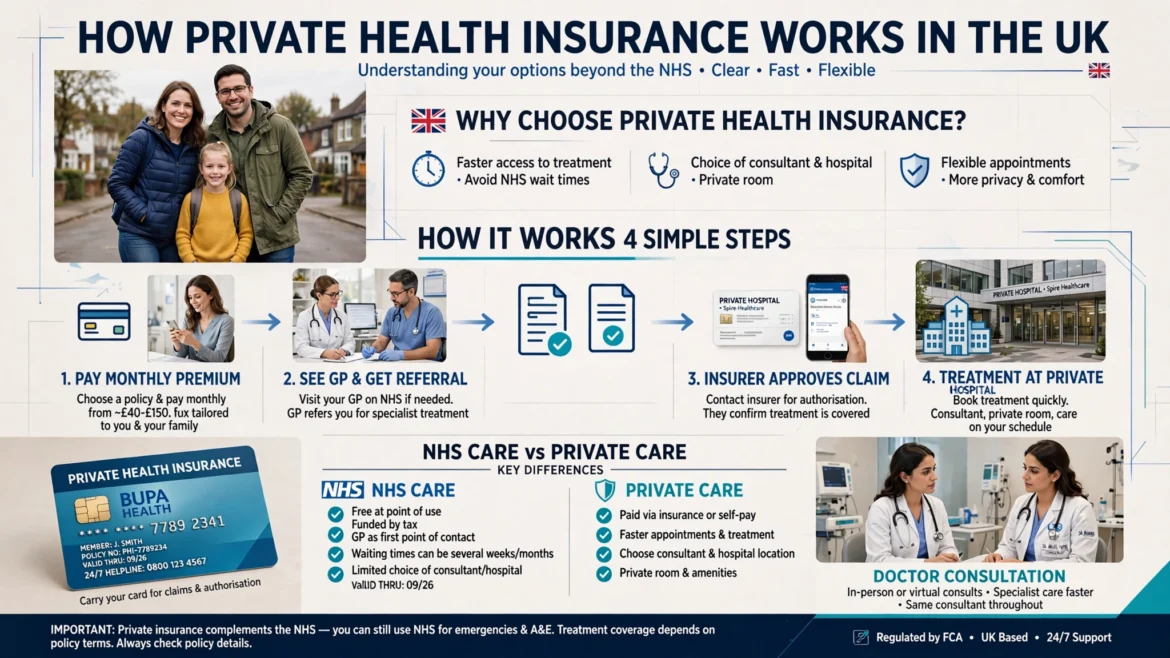
Private health insurance can look simple from the outside: you pay a monthly premium and receive private medical care when you need it. In practice, the arrangement is more precise. Your policy pays only for eligible treatment, provided by approved clinicians and hospitals, within the limits and exclusions written into the contract.
In the United Kingdom, private medical insurance is generally used alongside the NHS rather than instead of it. Most UK residents are entitled to NHS healthcare, while a private policy can provide another route for certain consultations, tests and planned treatments. MoneyHelper describes private medical insurance as cover that pays some or all of a person’s medical bills when they are treated privately.
The value of a policy therefore depends less on the word “private” and more on the details: what conditions are covered, how medical history is assessed, which hospitals can be used, how much outpatient cover is included and what the policyholder must pay towards a claim.
What It Is
Private health insurance, also called private medical insurance or PMI, is a contract between an individual or employer and an insurer. The insurer agrees to pay eligible private healthcare costs in return for a monthly or annual premium.
Most policies are designed primarily for acute conditions. These are illnesses, injuries or episodes that are expected to respond to treatment and improve. Examples might include a hernia requiring surgery, a new knee injury, cataracts or investigations into unexplained symptoms.
The cover is not an open-ended promise to pay every healthcare bill. It works according to a defined policy guide, benefit schedule, hospital list and underwriting terms.
Basic policies commonly concentrate on inpatient and day-patient treatment. Broader plans may add outpatient consultations, diagnostic tests, therapies, mental healthcare or enhanced cancer cover. MoneyHelper notes that the level of cover depends on the policy and provider, with basic plans usually concentrating on inpatient tests, surgery and day-case procedures.
The NHS Role
Buying private health insurance does not normally remove a person’s right to NHS care. The two systems can be used at different times.
Someone may choose private care for one episode while continuing to use the NHS for GP appointments, emergency treatment, maternity services, long-term condition management or other needs.
Government guidance for England states that a patient who pays for additional private care retains entitlement to NHS services. However, NHS-funded and privately funded treatment should be kept clearly separate, with it made clear which organisation is paying for each part of the care.
Arrangements differ in detail across England, Scotland, Wales and Northern Ireland, but the practical point remains: PMI is a supplementary route, not a replacement public health system.
It is also worth remembering that NHS patients may sometimes receive treatment in independent hospitals when those providers are working under an NHS contract. That is still NHS-funded care and is different from using a personal insurance policy.
Buying Cover
An individual can buy a policy directly from an insurer, through a specialist broker, through a financial adviser or through some comparison services. Cover may be arranged for one person, a couple or a family.
MoneyHelper also identifies banks, building societies and certain retailers as possible sources of private medical insurance. The range of sellers makes comparison important because similarly named products may provide very different benefits.
The other main route is an employer scheme. A company may pay the whole premium, share the cost with employees or simply provide access to a group rate.
Employer schemes can have different underwriting rules and benefits from policies sold directly to individuals. Some schemes include only the employee, while others allow a partner and children to be added for an extra charge.
Before comparing prices, a buyer should decide what the policy is expected to do. Someone mainly concerned about the cost of major surgery may choose strong inpatient cover with limited outpatient benefits.
Another person may value rapid access to specialists, scans, physiotherapy or mental health treatment and therefore need a broader plan.
Medical Underwriting
Underwriting is the process an insurer uses to decide which medical conditions it will cover. For individual UK policies, the two common approaches are full medical underwriting and moratorium underwriting.
With full medical underwriting, the applicant answers questions about health, symptoms, previous treatment and medical history before cover begins. The insurer then confirms any exclusions.
The insurer may request information from the applicant’s GP with permission, although this is not required in every case.
The applicant should answer every question accurately and fully. The Association of British Insurers warns that incomplete or inaccurate information can lead to a reduced claim payment, a rejected claim or cancellation of the policy.
With moratorium underwriting, the applicant usually provides less medical information when joining. Instead, the insurer checks the person’s medical history when a claim is made.
Conditions for which the person experienced symptoms, sought advice, took medication or received treatment during a stated look-back period are normally excluded initially.
The look-back period is often five years, but policy wording varies. Some moratorium policies may later cover a condition after the member has completed a defined continuous period without symptoms, medication, advice or treatment.
This is frequently two years under certain products, but it should never be assumed without reading the actual contract.
Pre-Existing Conditions
A pre-existing condition is a health issue that began, produced symptoms or required medical attention before the relevant cover date. Most individual private medical insurance policies do not automatically cover these conditions.
The exclusion can extend beyond the original diagnosis. A policy may also exclude complications, recurring symptoms or related treatment.
That is why a minor-sounding note in a medical record can become important when a later claim is reviewed. The insurer may look at when symptoms first appeared rather than only the date on which a formal diagnosis was made.
Some employer schemes offer more generous treatment of medical history, particularly where the employer has purchased medical-history-disregarded terms.
However, group cover is not automatically unrestricted. The Association of British Insurers explains that group schemes vary, with basic plans covering only certain admissions and tests while more extensive schemes provide additional benefits.
Employees should read the membership certificate and benefit schedule rather than relying on a brief workplace description.
A policy should be purchased for protection against eligible future conditions, not as a way to fund treatment that is already known to be needed.
Typical Cover
Many UK policies are built around inpatient and day-patient care. Inpatient care involves admission to hospital, usually including an overnight stay.
Day-patient care involves admission to a bed or clinical unit without staying overnight.
Eligible benefits may include hospital accommodation, nursing, surgeons’ and anaesthetists’ fees, operating theatre costs, diagnostic tests and medicines used during covered treatment. Some plans also include follow-up care for a limited period.
Outpatient cover can be just as important because diagnosis often begins before hospital admission. Depending on the plan, it may pay for specialist consultations, blood tests, X-rays, MRI or CT scans and certain therapies.
Outpatient benefits may be unlimited, capped at an annual amount or excluded from a lower-cost policy. MoneyHelper confirms that broader policies may cover outpatient specialists and consultants, while more basic plans generally concentrate on inpatient and day-case treatment.
Cancer benefits deserve close attention. Policies can differ in their approach to diagnosis, surgery, radiotherapy, chemotherapy, targeted medicines, ongoing monitoring and end-of-life care.
Mental health, physiotherapy and other therapies may also be optional, capped or subject to separate referral rules.
Common Exclusions
Private medical insurance is not intended to pay for every form of healthcare.
MoneyHelper lists several areas that are commonly excluded, including pre-existing conditions, normal pregnancy and childbirth, cosmetic treatment, organ transplants and ongoing chronic illnesses. Individual policies may contain additional exclusions.
Routine GP visits, dental care, eye tests, hearing aids, preventive screening and vaccinations are often outside core PMI unless the insurer has added a specific service or benefit.
A digital GP app provided with a policy may be useful, but services described as non-contractual can be changed or withdrawn.
Long-term conditions create particular confusion. A policy might pay to investigate symptoms or treat an acute flare-up, then stop funding once the condition is considered chronic and requires continuing monitoring or maintenance.
Diabetes, epilepsy and high blood pressure are examples of conditions commonly managed through the NHS rather than covered indefinitely by PMI.
Experimental treatment, unlicensed uses of medicines and treatment outside recognised clinical practice may also be restricted.
The consultant’s recommendation alone does not guarantee payment. The treatment must also satisfy the policy definition of eligible care.
Making a Claim
The usual claims journey begins with a health concern and, for many conditions, a GP appointment.
The GP may provide either a named referral or an open referral, which identifies the type of specialist required without naming a particular consultant. The NHS also advises patients seeking a private specialist to obtain a referral letter from their GP, even where a private provider may accept a patient without one.
The policyholder should then contact the insurer before arranging consultations, scans or treatment.
The insurer checks whether the condition appears eligible, whether the necessary benefit is included and whether the proposed consultant and hospital are recognised under the policy.
When a claim is approved, the insurer normally issues a pre-authorisation or claim number. The hospital or specialist uses that reference when invoicing.
Insurers often pay authorised bills directly to the healthcare provider, although the member remains responsible for an excess, uncovered fees or any amount above a policy limit. Current claims guidance from major UK insurers stresses the importance of contacting the insurer before treatment to prevent unexpected costs.
Authorisation is not always approval for an entire course of care. Further tests, a different procedure or additional treatment may require fresh approval.
A sensible habit is to ask the insurer exactly what has been authorised, which provider can be used, what limits apply and whether any personal payment is expected.
Hospital Networks
Many policies restrict treatment to a defined hospital and consultant network. A cheaper plan may use a smaller local or guided list, while a higher-priced option may provide broader national access.
This detail matters more than it first appears. A nearby private hospital may not be included, and a preferred consultant may not be recognised for the required procedure.
Using a provider outside the approved list can leave the patient responsible for part or all of the bill. AXA Health, for example, advises members to check before receiving private treatment and warns that only part of the cost may be paid when a hospital is outside the relevant list.
Some insurers use guided-care arrangements in which they help select an appropriate specialist after an open referral.
This can reduce premiums and simplify booking, but it gives the member less freedom to choose a particular consultant.
Before buying, check the network against realistic needs: nearby hospitals, specialist centres, travel distance, parking, public transport and access to teaching hospitals where complex treatment may take place.
Excesses and Limits
An excess is the amount the policyholder agrees to contribute towards eligible claims.
Depending on the contract, it may apply once per policy year, once per person, once per condition or to each claim.
A higher excess usually lowers the premium, but it also increases the amount that must be available when treatment is needed. A £500 excess is not a saving if paying it would cause financial difficulty.
Policies may also use outpatient limits, therapy session limits, benefit caps, co-payments or shortfalls.
A shortfall occurs when a provider charges more than the insurer’s recognised fee or when treatment exceeds the policy allowance.
Some plans include a no-claims discount, meaning premiums can be affected by claim activity as well as age and medical-cost inflation. MoneyHelper recommends checking excesses, no-claims discounts, treatment limits and drug limits before buying.
The cheapest quote should therefore be compared on total likely cost, not premium alone.
Policy Costs
Premiums vary because insurers price several factors. These may include the member’s age, postcode, policy design, hospital network, excess, outpatient limit, underwriting basis and number of people covered.
Prices often rise at renewal. Healthcare costs change, people become older and claims experience may affect certain products.
A policy that is affordable at the start should also be considered against the household’s likely budget several years later. MoneyHelper warns that premiums can increase with age and at annual renewals.
Private medical insurance is generally treated as taxable general insurance. HMRC’s standard Insurance Premium Tax rate is currently 12 per cent, and IPT is usually included in the insurance price paid by the customer.
Paying monthly may be convenient, but some insurers charge more than they do for one annual payment. Buyers should compare the annual total rather than looking only at the monthly figure.
Employer Policies
Workplace private medical insurance can be valuable because group schemes may offer broader access or lower effective costs than an individually purchased plan.
The employer also handles much of the initial administration. However, an employee is usually a beneficiary rather than the legal policyholder.
The company chooses the insurer, benefits and renewal decisions. Cover may end when employment ends, although the insurer might offer a continuation policy.
Employer-funded medical insurance is usually a taxable benefit in kind. GOV.UK states that employees normally pay tax on the cost of premiums paid by their employer, subject to limited exemptions.
Anyone relying on workplace cover should understand who is included, whether dependants cost extra, what happens during leave or redundancy and whether ongoing claims can continue after leaving the scheme.
The Financial Ombudsman Service also notes that an employee covered under a group policy can complain about the handling of an individual claim. Complaints about the original sale of the group policy, however, may need to be made by the employer.
Switching Insurers
Switching can reduce premiums or improve benefits, but health insurance is not as simple to move as home or motor cover.
A condition that began after the old policy started may be treated as pre-existing by a new insurer.
Some providers offer switch underwriting intended to preserve existing terms, but the rules and evidence requirements differ. The new policy should be accepted and its exclusions confirmed before the old cover is cancelled.
Check whether the hospital list changes, whether ongoing claims are protected, whether moratorium periods restart and whether a new excess or no-claims structure applies.
MoneyHelper warns that switching can be difficult when a person has developed medical conditions since buying the original policy, as the same cover may no longer be available elsewhere.
A lower renewal quote is not a better deal if it quietly removes valuable continuity.
Choosing Well
Start with the policy document rather than the marketing page.
Look for definitions of acute and chronic conditions, pre-existing conditions, eligible treatment, recognised providers and reasonable and customary fees.
Then compare the practical limits: inpatient care, outpatient consultations, diagnostics, cancer treatment, mental health, therapies, hospital access, excess and overseas cover.
Ask for examples of how the insurer would handle a typical claim. Do not accept a broad assurance that “everything is covered” without checking the written terms.
It is also sensible to confirm the complaints process. If a claim dispute cannot be resolved directly, the policyholder must first make a formal complaint to the insurer.
The Financial Ombudsman Service says a consumer can generally take the matter to it if the firm has not issued a final response within eight weeks or if the consumer is dissatisfied with the response.
Keep policy documents, authorisation messages, invoices and notes of phone calls. Many insurance disputes turn on the exact wording used and what was authorised at a particular time.
Other Options
Private medical insurance is only one way to pay for private healthcare.
A person may choose to self-pay for a consultation, scan or procedure instead of paying premiums every year. This may suit someone with enough savings who wants occasional access to private care rather than continuing insurance.
A six-week policy is another option. It usually provides private treatment only when the NHS cannot offer eligible treatment within a defined waiting period.
This can cost less than full cover but is less useful when the NHS can provide care within the policy threshold. The Financial Ombudsman Service identifies six-week plans as a distinct form of cover that may fund private treatment when the NHS wait exceeds six weeks.
Health cash plans are different from PMI. They usually reimburse part of routine costs such as dental treatment, glasses or physiotherapy up to annual limits.
They are not designed to cover the full cost of major private surgery. MoneyHelper describes cash plans as products that pay towards routine health expenses up to specified limits.
Someone whose main concern is income during illness may need income protection more urgently than medical insurance. PMI pays eligible healthcare bills; it does not normally replace salary while a person is unable to work.
Is It Worth It?
Private health insurance may suit people who place a high value on quicker access to eligible planned care, a wider choice of appointment times or private facilities.
It may also appeal to self-employed people who are concerned about delays keeping them away from work. MoneyHelper notes that some self-employed people buy medical insurance because waiting for treatment could lead to time away from work and lost earnings.
It may offer less value to someone who is comfortable relying on the NHS, has substantial savings for occasional self-pay treatment or would struggle to maintain premiums at renewal.
It is also unlikely to solve an immediate need involving an existing condition.
The best policy is not the one with the longest benefit list. It is the one whose exclusions, limits and claims process match the buyer’s priorities and budget.
Before signing, read the full terms, ask direct questions and keep written confirmation of important answers. Private health insurance works well when expectations match the contract.
Common Questions
Does private health insurance replace the NHS?
No. It normally gives you an additional private route for eligible treatment while you remain entitled to NHS care. NHS-funded and privately funded treatment should be recorded and delivered separately where required.
Will it cover a condition I already have?
Most individual policies exclude pre-existing conditions, although the exact treatment depends on the underwriting method. Some employer schemes may offer wider terms, and some moratorium policies may reconsider a condition after a specified symptom-free period.
Do I need a GP referral?
Often, yes. Many claims begin with a GP referral, followed by approval from the insurer. Some policies offer direct-access pathways for selected problems, such as certain muscle, joint or mental health conditions, so the member should check before booking.
What does an excess mean?
An excess is the part of an eligible claim that you pay yourself. The policy will state whether it applies once a year, once per person, per condition or in another way.
Can an insurer refuse a claim after treatment starts?
Payment can be restricted if the treatment was not authorised, the provider was outside the network, a benefit limit was reached or the condition was excluded. Contacting the insurer before each new stage of treatment reduces the risk of unexpected bills.
Read more: Business Insurance Quotes: How to Compare Coverage, Cost,…
